

Success Story (1):
The Home That Regained Its Calm Through Reading
Reading played a major role in reshaping our daily routine—especially during the summer break—through our participation in the Family Reading Challenge. We can truly say it not only continued, but also grew over time. We made the most of our mornings by visiting the public library, where we read and summarized books and stories, and attended several workshops offered there. Over time, my daughters even became trainers for some of these workshops.
This was the first summer in which we managed to reduce and regulate screen time—whether electronic devices or television—setting a clear maximum of only three hours per day. The final hours of the day, which used to be spent watching TV or playing electronic games, were dedicated to reading instead. The atmosphere at home became noticeably calmer; the presence of books and stories provided a meaningful alternative to devices and eliminated the anger, arguments, and clashes that used to happen during the last hour before bedtime.

Challenges:
- Excessive use of electronic devices and television.
- Wasting vacation time without meaningful activities.
- Tension and frequent arguments within the family.
Solutions:
- Setting a daily schedule for reading and library visits.
- Participating in workshops and reading-related activities.
- Regulating device usage with a clear time limit.
- Involving children in leadership and motivational roles.
Results:
- A noticeable reduction in screen time.
- A calmer family environment with stronger bonding and connection.
- Establishing reading as a daily family habit.
Reading is not an extra activity… it is a way of life that makes a real difference in your day—and your family’s.
Success Story (2):
Reading: The Path to Understanding in Parenting
Reading played a significant role in transforming my life and stabilizing my family. I began my parenting journey with daughters, and I grew used to raising them with ease. However, when I later had a son, I started facing challenges—dealing with him was not as effortless as it had been with his sisters, nor was it as enjoyable and smooth. This difference pulled me into a cycle of anxiety and stress, as I struggled with his behaviors.
Yet I had a strong desire to understand the reasons and make a change. I began searching through books to understand this difference and to find an easier approach—one that would help me regain the same sense of joy I had known while raising girls. Through reading, I found my path toward sound parenting for both genders. I began to recognize differences, observe them, and respond in ways that suited each of my children. The results were remarkable: I was able to guide my children according to their different talents and abilities into diverse activities and settings. Today, I see the fruits of that effort in their character, the love people have for them, their skills and potential, and their participation in various activities and events.

Challenges:
- Difficulty parenting a son compared to daughters.
- Anxiety and stress caused by differences in behavior.
- Lack of knowledge about appropriate parenting approaches for each child.
Solutions:
- Reading parenting books and understanding individual differences.
- Applying different parenting methods suited to each child’s personality.
- Guiding children toward activities based on their talents and abilities.
Results:
- A clear improvement in children’s behavior and overall family stability.
- Discovering children’s talents and guiding them more effectively.
- Building a more aware and balanced parenting relationship.
When we read, we parent with awareness, guide with wisdom, and build confident personalities for the future.
Success Story (3):
From Stuttering to Confidence
My daughter used to struggle with stuttering and speech disfluency, especially during family gatherings. At times, she spoke slowly and in broken phrases. This had a significant negative impact on her—particularly when she tried to speak with people she was meeting for the first time, or in crowded places.
We did not stop searching for a solution. We consulted a speech therapist, who advised training in breathing techniques and maintaining specialized exercises to improve verbal performance—through repeated, confident reading aloud, especially from books with positive meanings. With consistent daily reading exercises—supported greatly by our participation in the Family Reading Challenge for motivation and continuity—by God’s grace, we achieved the results we hoped for. My daughter now enjoys participating in school and community events and shares knowledge in an inspiring way that reflects her personality and self-confidence.

Challenges:
- Stuttering and speech disfluency.
- Low self-confidence and fear of speaking in front of others.
- Difficulty maintaining a consistent training program.
Solutions:
- Seeking support from a speech therapist.
- Committing to breathing exercises and daily reading aloud.
- Choosing books with meaningful and positive content.
- Leveraging the Family Reading Challenge to strengthen consistency.
Results:
- Clear improvement in pronunciation and verbal fluency.
- Increased self-confidence and social participation.
- Turning reading into a tool for personal support and development.
Through reading, we plant courage, release the voice, and grow confidence in our children’s hearts.
Success Story (4):
Books as a Path to Healing
Witnessing the sudden death of a close relative was like a shock that shook my entire being. After that, I lived through the hardest period of my life. Outwardly, everyone thought I had moved on—but in reality, I was reliving the event every day. Memories kept returning: the image of death, the scent of camphor, the sounds of crying. The entire scene replayed in my mind, and I could not move past it.
I kept searching for an escape—closing my eyes, hoping it would end—yet it continued to repeat. During that journey, I found refuge, after God, in books. I immersed myself in reading with deep focus. At first, moments of distraction and wandering thoughts appeared between the pages, but with time I truly began to sink into the book and its ideas. I would then reflect on what I read and strive to apply it in my life, practicing the skills I learned. By God’s grace and blessing, I was able to move beyond that stage and accept what happened. Since then, I have consistently turned to reading whenever I face difficulties, searching for solutions to challenges and obstacles within the books I choose.

Challenges:
- Severe psychological shock due to sudden loss.
- Recurrent painful memories, anxiety, and mental distraction.
- Difficulty adapting to life after the experience.
Solutions:
- Turning to reading as a form of emotional and psychological support.
- Maintaining consistency in reading and reflecting on the content.
- Applying ideas and learned skills in daily life.
Results:
- Improved ability to adapt and move forward beyond the crisis.
- Greater emotional resilience in facing hardships.
- Establishing reading as a lasting tool for self-support.
When life feels heavy, we find in reading the strength to understand, overcome, and heal.
Success Story (5):
When the Book Became a Member of the Family
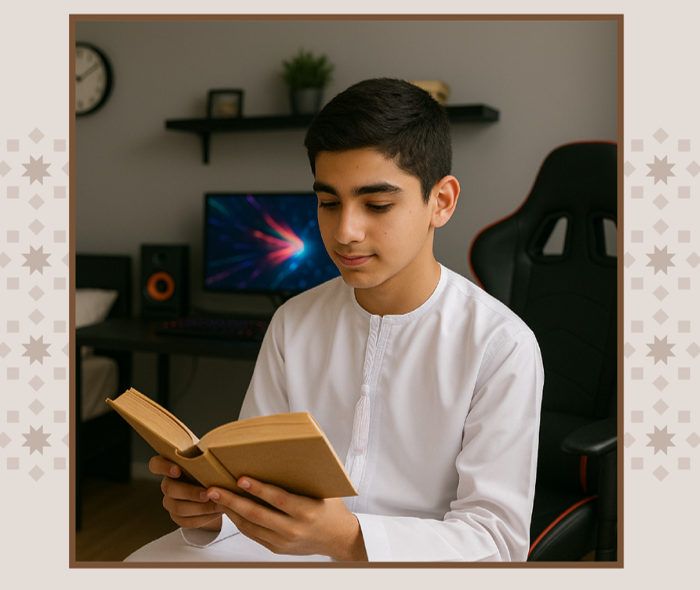
Like many families today, electronic devices became a heavy guest in our home—pulling our children into a world filled with frightening risks that none of us can ignore. Addiction to games and screens became a source of constant worry for me, especially with my eldest son, who rejected any alternative activities that might attract his younger siblings. He saw those activities as “for kids” and not suitable for him.
Reading was the rescue. I managed to draw him into it, and he began to see it as an activity for “grown-ups”—especially since his father and I also sat down to read, becoming role models for him. Over time, I made reading a daily family commitment for everyone—an essential task that must be completed in order to earn device time. Additional screen hours were tied directly to the number of hours spent reading as a motivational system.
That is when I began to see screen use decline: the book started competing with the device and sharing time with it, leaving my children with far less time to sit on screens. More than that, through our participation in the Family Reading Challenge, our time gained meaning and quality unlike before. Our conversations began to revolve around book titles and topics, and this developed into the amount of time we spent together as a family—gathering and discussing themes we would never have explored without books and reading.
Through this experience, I encourage every family to treat the book as a permanent member among them—to make reading a habit that children and all family members seek, and to dedicate enough time to taste and feel its positive impact on every individual.
Challenges:
- Children’s addiction to electronic devices.
- The eldest child’s refusal of alternative activities.
- Limited shared family time and meaningful dialogue.
Solutions:
- Presenting parents as role models in reading.
- Linking device use to reading hours (a motivational system).
- Making reading a shared daily family activity.
- Participating in the Family Reading Challenge to boost motivation.
Results:
- A noticeable decline in screen time.
- More shared family time and higher-quality dialogue.
- Establishing reading as a sustainable family habit.
We do not forbid… we inspire. We do not restrict… we open doors to imagination, knowledge, and family dialogue.